






Australian Aboriginal culture is one of the oldest continuous living cultures in the world, with a history that stretches back more than 60,000 years. Far from being a relic of the past, Aboriginal culture remains a dynamic and evolving system of knowledge, beliefs, social structures, and artistic expression. It is deeply connected to the land, shaped by complex spiritual philosophies, and sustained through oral traditions, ceremonies, and community relationships.
Understanding Australian Aboriginal culture requires moving beyond simplified narratives. It involves recognizing the diversity of Aboriginal nations, the sophistication of their ecological knowledge, and the resilience of their cultural systems despite colonization, displacement, and historical injustice. This article offers a comprehensive, professional, and respectful exploration of Australian Aboriginal culture, examining its foundations, values, artistic traditions, social organization, contemporary expressions, and global significance.
1. The Diversity of Aboriginal Australia
1.1 Many Nations, Not One Culture
Before European colonization, Australia was home to over 250 Aboriginal nations, each with its own language, laws, customs, and spiritual traditions. These groups were not isolated but connected through trade routes, marriage systems, and shared ceremonial practices.
Aboriginal Australia should therefore be understood as a cultural mosaic, not a single homogeneous society. Cultural expressions, artistic styles, kinship systems, and land management practices varied widely depending on geography and environment.
1.2 Connection to Country
A central concept in Aboriginal culture is “Country”, which refers to more than physical land. Country encompasses:
- Landforms and waterways
- Plants and animals
- Ancestral beings and spiritual presence
- Cultural identity and responsibility
Country is alive, sentient, and relational. Caring for Country is both a spiritual duty and a practical system of environmental stewardship.
2. Ancient Origins and Archaeological Evidence
2.1 The Longest Continuous Human Presence
Archaeological evidence indicates that Aboriginal peoples arrived in Australia at least 60,000 years ago, possibly earlier. Sites such as rock shelters, stone tools, and ceremonial grounds demonstrate sophisticated adaptation to diverse environments, from deserts to rainforests.
This longevity challenges outdated assumptions about “primitive” societies and highlights the remarkable resilience and adaptability of Aboriginal cultures.
2.2 Innovation and Environmental Adaptation
Aboriginal Australians developed advanced technologies suited to their environments, including:
- Stone tools and spear systems
- Fish traps and water management structures
- Fire-based land management techniques
These practices were underpinned by deep ecological knowledge passed down through generations.
3. The Dreaming: A Foundation of Worldview
3.1 Understanding the Dreaming
The Dreaming (often referred to as Dreamtime) is a complex spiritual and philosophical system that explains the origins of the world, social laws, and moral values. It is not a mythological “past” but an ever-present reality connecting ancestors, land, and living people.
Dreaming stories describe ancestral beings who shaped the land, created life, and established laws governing behavior, relationships, and responsibility.
3.2 Law, Ethics, and Identity
The Dreaming functions as:
- A legal system defining rights and obligations
- A moral framework guiding behavior
- A spiritual map linking people to specific places
Identity in Aboriginal culture is inseparable from Dreaming stories and ancestral connections to Country.
4. Language and Oral Traditions
4.1 Linguistic Richness
Before colonization, Australia had hundreds of distinct languages and dialects. Language is central to cultural transmission, carrying:
- Ecological knowledge
- Kinship rules
- Spiritual concepts
Many languages are endangered today, but revitalization efforts are ongoing through community-led education and documentation projects.
4.2 Storytelling as Knowledge Preservation
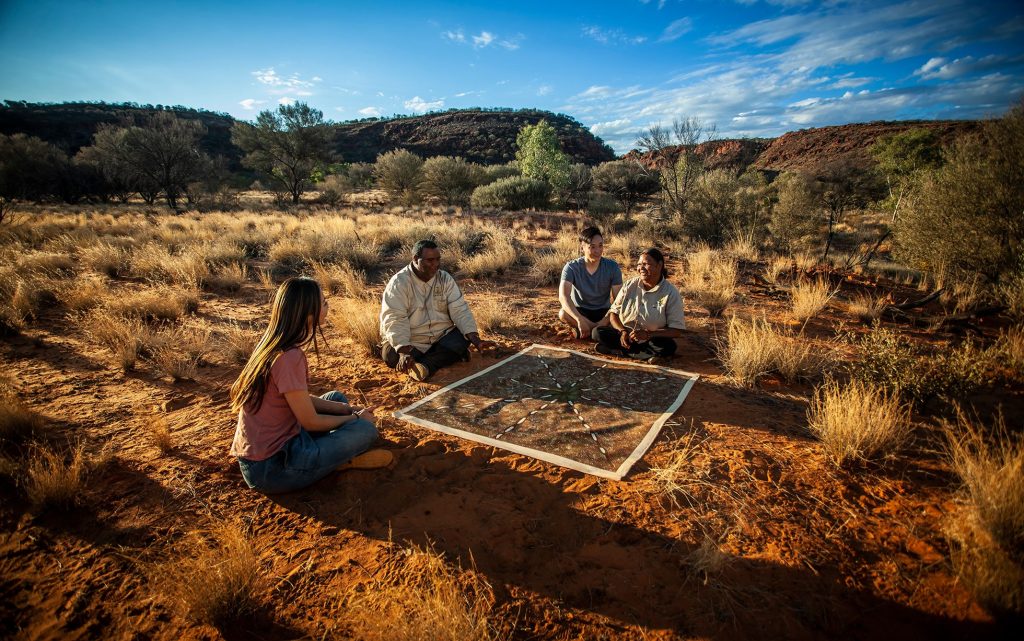
Aboriginal cultures rely on oral traditions rather than written texts. Stories, songs, and dances serve as tools for teaching history, law, survival skills, and spiritual understanding.
Oral traditions are not static; they adapt to changing circumstances while preserving core values.
5. Social Organization and Kinship Systems
5.1 Kinship as Social Structure
Aboriginal societies are organized through intricate kinship systems that determine:
- Marriage rules
- Social responsibilities
- Relationships to land and resources
Kinship structures create strong networks of obligation, cooperation, and mutual care.
5.2 Elders and Knowledge Holders
Elders play a crucial role as custodians of cultural knowledge. They guide decision-making, conduct ceremonies, and ensure the transmission of traditions to younger generations.
Respect for Elders reflects the value placed on wisdom, experience, and continuity.
6. Art as Cultural Expression and Knowledge System
6.1 Rock Art and Ancient Visual Traditions
Australia contains some of the world’s oldest rock art, depicting animals, ancestral beings, and ceremonial scenes. These artworks function as:
- Historical records
- Spiritual maps
- Teaching tools
Rock art sites remain sacred and culturally significant today.
6.2 Contemporary Aboriginal Art
Modern Aboriginal art incorporates traditional symbols and techniques while engaging with contemporary themes. Dot painting, bark painting, weaving, and sculpture have gained international recognition.
Art is not merely decorative—it encodes ancestral knowledge, land relationships, and spiritual narratives.
7. Music, Dance, and Ceremony
7.1 Performance as Living Culture
Music and dance are integral to ceremonies marking life stages, seasonal cycles, and spiritual events. Instruments such as the didgeridoo are used alongside song and movement to tell stories and invoke ancestral presence.
7.2 Ceremonial Responsibility
Participation in ceremonies reinforces identity, community cohesion, and respect for cultural law. Ceremonies are carefully governed by rules about who may participate and how knowledge is shared.
8. Aboriginal Ecological Knowledge
8.1 Land Management and Sustainability
Aboriginal Australians practiced sustainable land management long before modern environmental science. Techniques included:
- Controlled burning to prevent wildfires
- Seasonal harvesting
- Species-specific conservation practices
These methods maintained biodiversity and ecosystem balance over millennia.
8.2 Modern Recognition of Traditional Knowledge
Today, Aboriginal ecological knowledge is increasingly integrated into:
- Conservation programs
- Climate adaptation strategies
- Land restoration projects
This recognition highlights the global relevance of Indigenous knowledge systems.
9. Impact of Colonization
9.1 Dispossession and Cultural Disruption
European colonization resulted in land dispossession, violence, and the disruption of cultural practices. Policies aimed at assimilation caused profound intergenerational trauma.
Despite these challenges, Aboriginal cultures endured through resilience, adaptation, and resistance.
9.2 Survival and Continuity
Cultural survival was maintained through:
- Oral transmission of knowledge
- Secret or restricted ceremonies
- Strong community bonds
Today, cultural revival movements play a central role in healing and empowerment.
10. Contemporary Aboriginal Identity
10.1 Cultural Revitalization
Modern Aboriginal communities actively reclaim language, ceremony, and cultural practices. Education, art, and political advocacy support cultural renewal.
10.2 Representation and Voice
Aboriginal Australians increasingly shape narratives about their culture through literature, film, academia, and leadership roles. This shift challenges stereotypes and promotes self-determination.
11. Aboriginal Culture in Global Context
11.1 Contribution to Global Indigenous Knowledge
Australian Aboriginal culture contributes valuable perspectives on:
- Sustainability
- Community-based governance
- Human-nature relationships
These perspectives resonate with global movements addressing climate change and cultural preservation.
11.2 Ethical Engagement and Cultural Respect
Engaging with Aboriginal culture requires respect, consent, and awareness of cultural protocols. Ethical tourism and education emphasize listening, learning, and reciprocity.
12. Learning from Aboriginal Worldviews
Aboriginal culture offers alternative ways of understanding time, ownership, and progress. Emphasis on intergenerational responsibility, balance, and respect for the natural world provides meaningful lessons for contemporary societies.
Rather than viewing culture as static heritage, Aboriginal traditions demonstrate how ancient knowledge can remain relevant in modern contexts.
13. Challenges and the Path Forward
Challenges facing Aboriginal communities include:
- Cultural loss due to globalization
- Social and economic inequality
- Environmental threats to sacred lands
Addressing these challenges requires genuine partnership, recognition of rights, and support for self-determined cultural futures.
14. Conclusion
Australian Aboriginal culture is a profound testament to human resilience, creativity, and wisdom. Rooted in ancient traditions yet alive in the present, it represents a holistic system of knowledge that integrates land, spirituality, community, and responsibility.
Understanding Aboriginal culture is not simply an academic exercise—it is an ethical and intellectual engagement with one of humanity’s most enduring cultural legacies. By listening respectfully and acknowledging the depth of Aboriginal knowledge, we gain insight not only into Australia’s past, but into shared global futures grounded in respect, sustainability, and connection.